Measuring Farmland Conversion
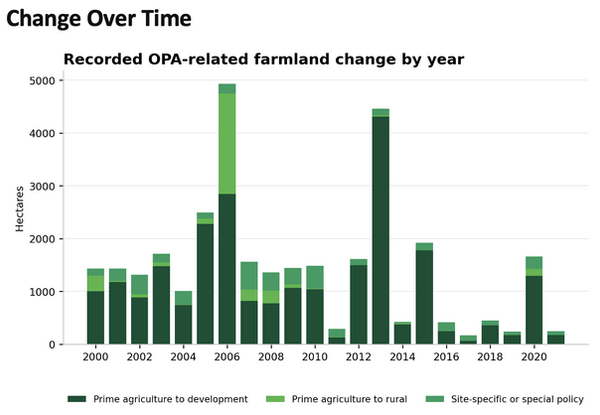
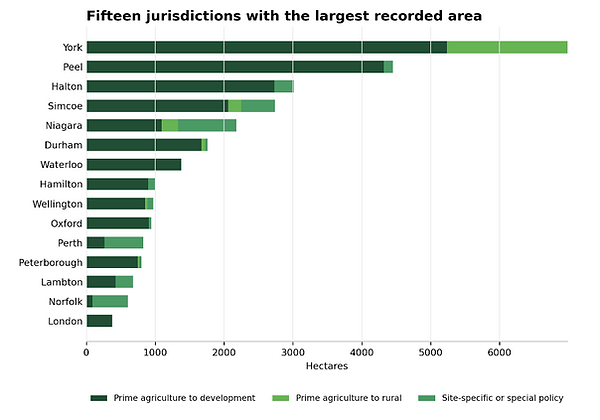
The updated farmland loss database provides a long-term view of how Ontario's prime agricultural land has been affected through Official Plan Amendments (OPAs)and related planning decisions over the 22-year period from 2000 to 2021. The project demonstrates that farmland conversion in Ontario is not a single, uniform process. Most recorded land loss is associated with large development-related redesignations concentrated in rapidly urbanizing jurisdictions, particularly within the Greater Golden Horseshoe. However, the high frequency of smaller site-specific and special-policy amendments—especially in rural municipalities—shows that incremental decisions can also create significant cumulative pressure on the agricultural land base.
A key insight is that the number of OPAs is not, on its own, a reliable measure of farmland loss. Some jurisdictions have many amendments affecting relatively small areas, while others experience substantial conversion through only a few large amendments. Farmland conversion must therefore be evaluated using both amendment frequency and hectares affected.
The findings also highlight the importance of consistent provincial monitoring, standardized municipal reporting and accurate spatial data. Without these, cumulative farmland conversion can be difficult to identify, compare and address through long-term land-use policy.
Summary of Data
The study documented 32,044.89 hectares of prime agricultural land affected by the three categories. Development-related redesignations represented the largest share, accounting for 24,505.06 hectares, or 76.5% of the recorded area. Rural conversions accounted for 3,171.09 hectares, while site-specific and special-policy amendments accounted for 4,368.74 hectares. The project identified 676 unique qualifying OPAs.
Conversion Trends
The findings show that farmland conversion occurs differently across Ontario. Rapidly urbanizing jurisdictions, particularly in and around the Greater Golden Horseshoe, experienced some of the largest development-related conversions. In other parts of the province, farmland was more often affected through numerous smaller rural, site-specific or special-policy amendments. As a result, the number of amendments alone does not indicate the scale of farmland conversion: a municipality may have many amendments affecting small parcels, while another may lose a large area through only a few decisions.